Doge's Palace: Tickets, Free Views And What To Know Before You Go
The Doge's Palace is the single most recognisable building in Venice, and almost nothing about seeing it is free inside. The good news is that the building's best views, the square it fronts, and several walks that explore the same history cost nothing at all.
Short answer
The Doge's Palace is not free to enter: it is part of the St Mark's Square Museums Ticket, EUR 35 standard or EUR 30 if bought online at least 30 days ahead. The palace has no first-Sunday free scheme. Piazza San Marco outside is free, and free pay-what-you-want walking tours cover the surrounding districts.
The Doge's Palace, the Palazzo Ducale, was the seat of the Venetian Republic's government, and it is the one building in Venice that almost every visitor ends up standing in front of. It anchors the western side of Piazza San Marco, faces the lagoon, and connects to the former prisons across the canal by the Bridge of Sighs. Inside are the council chambers, the armoury, the prisons and some of the largest painted interiors in Europe. Outside is a building you can read entirely from public ground, if you know what you are looking at.
This guide lays out what the palace costs, which parts of the experience are genuinely free, and how the free walking tours listed on this site cover the same ground. The palace itself is a paid attraction with its own tariff, and the free options are all around it: the square, the waterfront, the labyrinth of streets behind it, and the guided walks that operate on a pay-what-you-want basis across the city.
What Is The Doge's Palace And Why Does It Matter?
The Doge's Palace was the political heart of the Venetian Republic: it housed the Doge, the Great Council, the Senate, the courts and the state prisons under one roof, and its architecture was deliberately designed to project the power and stability of a state run by law rather than by a single ruler. The building you see today is the product of successive rebuildings after earlier wooden and brick structures on the site were destroyed by fire. The pink and white pattern of the facade, the arcade of pointed arches at ground level, and the heavy upper storey balanced on slender columns are the signature of Venetian Gothic, a style that fused Byzantine, Islamic and northern European influences into something the Republic used as a visual statement of its wealth and its reach.
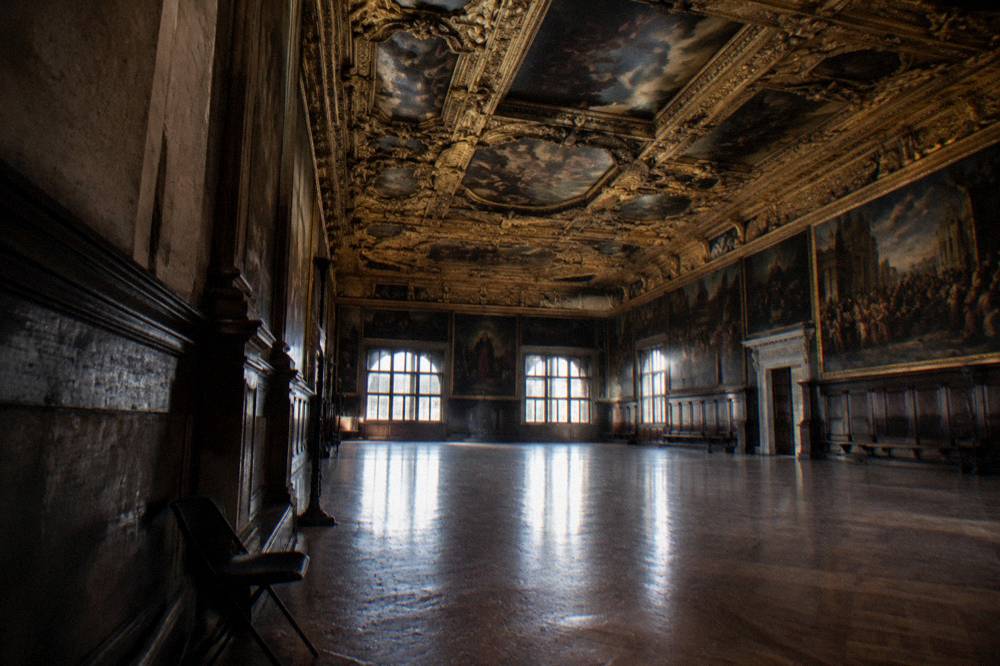
The palace's role went far beyond housing a prince. The Doge was not a monarch in the ordinary sense; he was elected, held office for life under constant surveillance by the state's councils, and was effectively a ceremonial head constrained by layers of institutions. The rooms inside the palace map that system directly: the Chamber of the Great Council, where the entire patriciate voted; the halls of the Senate and the Council of Ten; the armoury; and the courtrooms from which prisoners were led across the Bridge of Sighs into the lead-roofed prisons known as the Piombi. The interior decoration was itself propaganda, with vast painted canvases celebrating the state's myths and victories at enormous scale.
Understanding even a fraction of this before you arrive changes how the building reads from the outside. The arcade facing the piazzetta, the loggia where dukes and dignitaries appeared, the column markers where decrees and executions were proclaimed, all of it was machinery for governing an empire that stretched across the Adriatic and the eastern Mediterranean. The palace is also the anchor point for the whole San Marco complex, which is why so many visitors plan their entire first day around it. For a wider picture of how to fit the area into a visit, the things to do in Venice overview places the palace in context with the rest of the city.
How Much Does It Cost To Go Inside The Doge's Palace?
Entry to the Doge's Palace is not free and never has been: it is part of the St Mark's Square Museums Ticket, which costs EUR 35 at standard rate or EUR 30 if bought online at least 30 days ahead of the visit. The palace is a civic museum run by the MUVE foundation, and MUVE museums have their own tariff with no first-Sunday free scheme for visitors. That last point matters, because Venice's museum regimes are frequently confused with each other. The Domenica al Museo first-Sunday scheme applies to state museums, and in Venice the only state museum confirmed on its own page as participating is the Gallerie dell'Accademia. The Doge's Palace is not a state museum in that sense, and no free day for ordinary visitors exists for it.
The Musei in Festa free days that MUVE runs are for residents of the Metropolitan City of Venice, not for tourists. If you read that the palace is free on certain festival days, that is the scheme being described, and it does not apply to visitors staying from elsewhere. The only way in is the ticket, and the online advance purchase saves EUR 5 per person if you can commit at least 30 days ahead. The ticket covers the palace itinerary, which includes the interior crossing of the Bridge of Sighs into the former prisons. That crossing is not sold separately and cannot be done without the palace ticket.
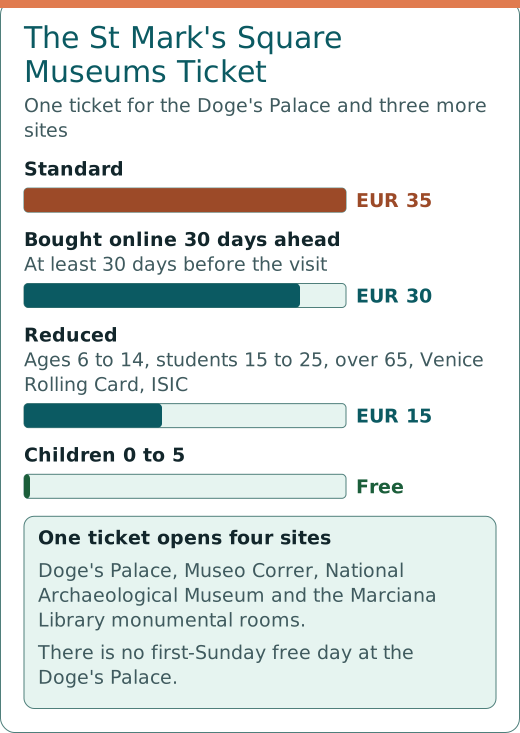
Here is how the paid options around the palace compare:
| Sight | Cost | What it covers | Notes |
|---|---|---|---|
| Doge's Palace (St Mark's Square Museums Ticket) | EUR 35, or EUR 30 online at least 30 days ahead | The palace itinerary including the interior Bridge of Sighs crossing | MUVE civic museum, no first-Sunday scheme for visitors |
| St Mark's Basilica | EUR 10 | Basilica entry under the Procuratoria's own tariff | A basilica ticket also admits the holder to 34 other sites within 6 months |
| Pala d'Oro | EUR 10 | The golden altarpiece behind the high altar | Separate paid layer inside the Basilica |
| Basilica museum, Loggia dei Cavalli and terrace | EUR 10 on top of the basilica ticket | Museum, terrace and loggia views | EUR 14 alone only when the basilica is closed for services |
| St Mark's Campanile | EUR 15 | Lift to the top of the bell tower | Separate ticket, separate queue |
The pattern to notice is that Piazza San Marco itself is free, and every layer of vertical or interior access is paid, each with its own tariff. The Basilica's full ticket, at EUR 30, bundles its own layers; the Campanile is entirely separate. Nothing here is bundled with the palace ticket, so budgeting for "the square" and budgeting for the palace are two different exercises. If your question is specifically whether the Basilica can be entered without paying, the St Mark's Basilica guide covers its entry rules in detail.
While the palace itself is fixed-cost, the ground around it rewards walking with a guide, and the free walking tours listed on this site are the cheapest way to get the history. The tours run on a pay-what-you-want basis, booked through GuruWalk and freetour.com, and the site's 17 free walking tours span the districts that made the Republic's wealth. Three of them suit a palace-centred visit especially well.
Can You See The Doge's Palace For Free From The Outside?
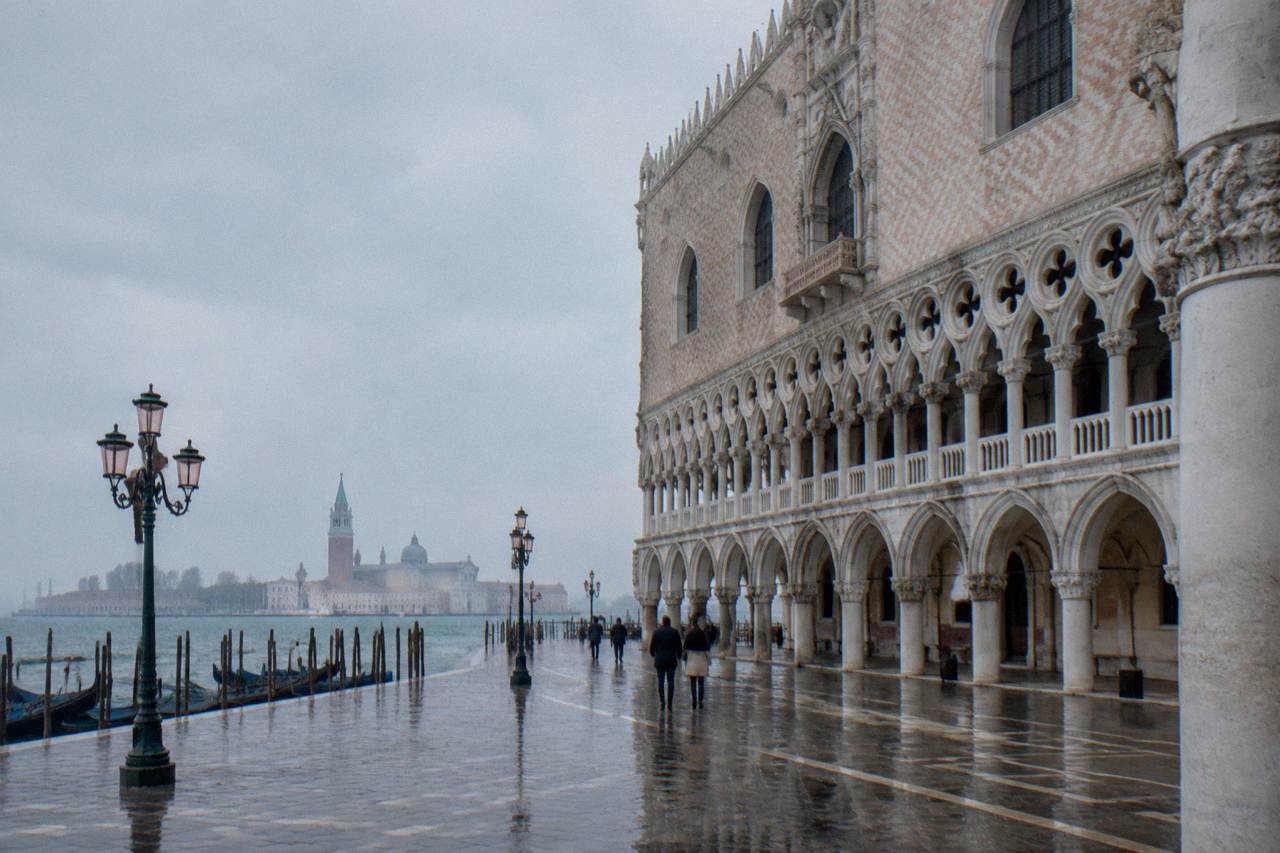
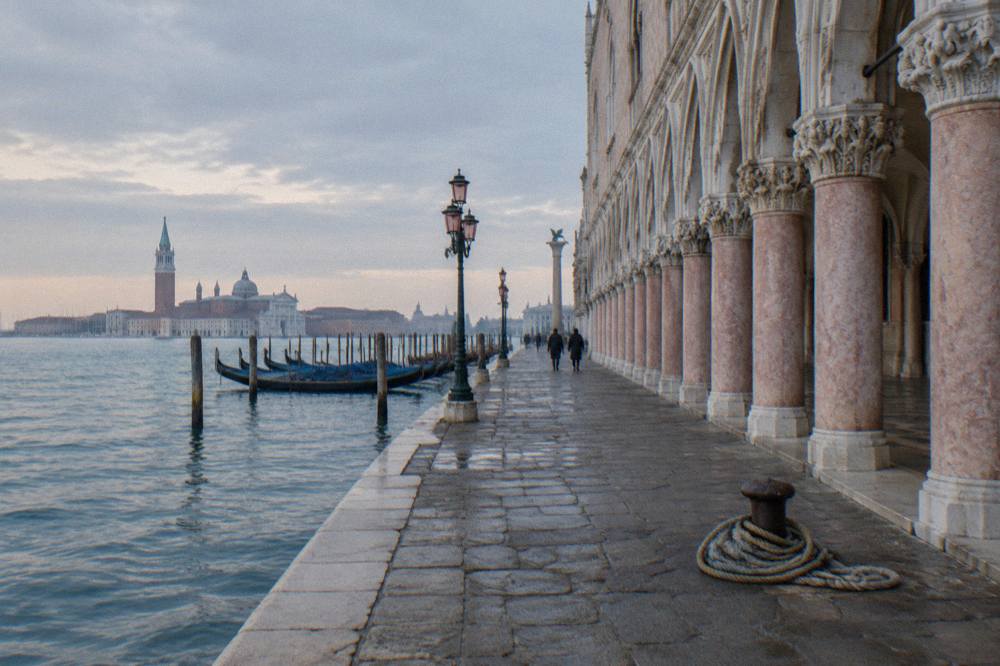
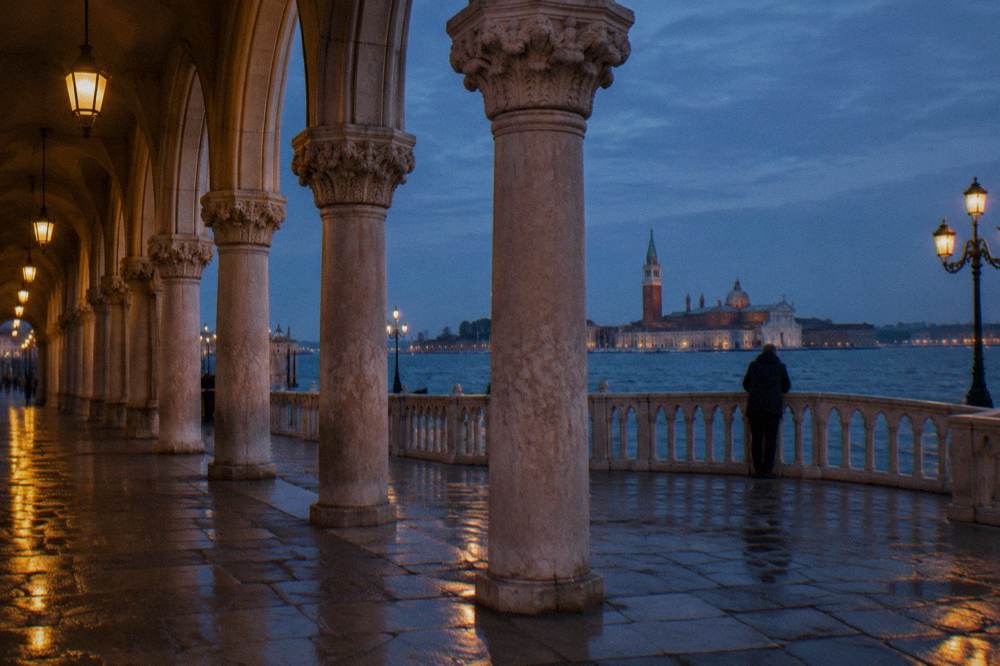
Yes, and in practical terms most of the palace's visual impact is free: the gothic facade on the piazzetta, the arcades, the lagoon frontage and the whole setting of Piazza San Marco can all be seen from public ground without a ticket, and the square itself costs nothing to enter at any hour. The palace was designed to be read from outside. The ground-level arcade along the piazzetta was the ceremonial entrance route for dignitaries arriving by water; the upper loggia was where the Doge appeared to the public; and the two great columns at the water's edge, carrying the lion of St Mark and the figure of St Theodore, framed the stage on which the Republic displayed itself. You can stand in all of that space for nothing.
The free layer of the San Marco experience is genuinely substantial. Piazza San Marco is free, and it is the only piazza in Venice that the Republic ever allowed to be called a piazza; every other square in the city is a campo. The waterfront between the palace and the basin, the Molo, is public. The view across the water toward San Giorgio Maggiore is public. Early morning and late evening, when the day-trip crowds thin, the square and the palace facade belong to whoever is standing there, and that costs nothing at all. The contrast with the interior is worth stating plainly: the paid ticket buys the council chambers, the prisons and the Bridge of Sighs crossing, but it buys nothing that improves the facade, because the facade was built to impress people who never went inside.
One caution for the free layer: the rules on public behaviour are enforced in this part of town more than anywhere else. Sitting on bridges, steps and monument bases to eat is against longstanding city rules, swimming in canals is banned, and tourist groups are capped at 25 people with loudspeakers prohibited. None of this affects ordinary visitors walking through, but it explains why the square stays clear of the informal seating you might expect in other Italian cities. If you are planning a budget day built around the free side of the square, the Venice on a budget guide works through how a no-ticket day can be structured.
If the palace's interior is beyond your budget, the history does not have to be. The free walks give you the Republic's story, told on the streets where it happened, for whatever you choose to pay at the end.
Is The Bridge Of Sighs Part Of The Doge's Palace Ticket?
The Bridge of Sighs is an enclosed passageway, not a viewpoint, and crossing it inside is part of the Doge's Palace itinerary, so it requires the palace ticket; the bridge cannot be walked through on its own and there is no separate free interior access of any kind. The bridge's name came later, from the romantic idea that prisoners sighed at their last view of the lagoon through its stone lattice as they crossed from the courtrooms into the prisons. Lord Byron popularised that image, and it has been attached to the bridge ever since, though the prisoners who crossed it were going to the Piombi cells or to the larger prison across the canal, not necessarily to execution.
What can be said is that the bridge spans a narrow canal between the palace and the former prison, it is visible from public streets and water in the area, and its white limestone bars stand out against the palace's pink brick. For the full history of the bridge and how its interior fits into the palace itinerary, see the Bridge of Sighs guide.
The practical point for planning is simple. If the Bridge of Sighs interior is on your list, the palace ticket is the only way to cross it, and the crossing is folded into the standard route rather than being a separate room you can skip or add. If you only want the photograph and the story, the exterior delivers both, and a free walking tour that covers the San Marco and Castello side of the city will put the bridge's history in context without any ticket at all. Everything else covered here is indexed on Free Things To Do In Venice.
What Is Free Around The Palace: The Square, The Waterfront And The Islands?
Piazza San Marco is free, the lagoon waterfront is free, and the islands of Murano, Burano and Torcello are free to walk, though their museums and the Torcello cathedral are paid; every paid layer around the palace, from the Basilica at EUR 10 to the Campanile at EUR 15, is a separate decision you can decline. This is the core of a budget visit to the San Marco district: the free layer is the public city itself, and it is enormous. The square, the piazzetta, the Molo, the view toward San Giorgio Maggiore across the basin, and the maze of streets running back from the palace into the Castello and San Marco districts are all open ground.
The free-pavement principle extends across the lagoon. Murano, Burano and Torcello cost nothing to walk, and their glass workshops, lace-fronted houses and quiet canals are the attraction; their museums are paid, and the Torcello cathedral is paid. Getting there costs money, because no free boat service exists for visitors: the ACTV vaporetto network charges EUR 9.50 for a 75-minute single ticket, EUR 25 for 24 hours, EUR 35 for 48 hours, EUR 45 for 72 hours and EUR 65 for 7 days, and the airport bus single is EUR 10. The vaporetto guide works through which passes pay off.
| Layer around the palace | Free or paid | Figure |
|---|---|---|
| Piazza San Marco and the Molo waterfront | Free | No ticket of any kind |
| Doge's Palace interior | Paid | EUR 35, EUR 30 online 30 days ahead |
| St Mark's Basilica entry | Paid | EUR 10 under the Procuratoria tariff |
| St Mark's Campanile | Paid | EUR 15 |
| Walking the islands (Murano, Burano, Torcello) | Free to walk | Museums and Torcello cathedral are paid |
| Vaporetto to the islands | Paid | EUR 9.50 single, EUR 25 for 24 hours |
Two seasonal facts are worth folding into any plan built on the free layer. Acqua alta season runs roughly October to March, with the peak in November and December when about three quarters of flooding events occur, and water can begin to affect Piazza San Marco from tides around 80 cm even though the MOSE barriers activate on forecasts above 110 cm at Punta della Salute. The city's tide centre publishes forecasts and real-time data, and raised walkways are not in service from about 1 May to 15 September. None of this costs a visitor anything, but it decides what shoes to pack and whether the square will be photogenic on a given morning.
Which Free Walking Tours Cover The Ground Near The Palace?
The free walking tours listed on this site cover the districts around the palace through independent local guides on a pay-what-you-want basis, and the walks that fit a palace-centred visit best are the Northern Districts walk from Campo de la Fava, the 3-Hour Hidden Venice walk from Campo San Geremia, and the Overlooked Highlights walk from Campo Sant'Agnese, all on GuruWalk and all free to book. These walks do not enter the palace, and no walk on this site does; what they do is give you the Republic's street-level history, the districts the palace governed, and the corners most visitors walk past between the square and their hotels. Sixteen of the site's 17 walks run on GuruWalk, with one on freetour.com, and every one is free with tips at the end.
The Northern Districts, Locals' Venice walk is the strongest match for a palace visit, because it starts at Campo de la Fava in Castello, the district that wraps around the eastern side of the San Marco complex, and it is rated 4.82 out of 5 across 3,020 GuruWalk reviews. It runs for 2 hours in English. Castello is where the Republic's shipyards and working quarters sat behind the ceremonial front, and a guide walking you through it explains the palace's economy better than any audio guide inside. The walk's free tour page has the meeting point and booking details.
For a longer immersion, the 3-Hour Hidden Venice Walk starts at Campo San Geremia in Cannaregio and is rated 4.76 out of 5 across 1,911 GuruWalk reviews over its 3-hour English route. Cannaregio is the district where the ordinary Republic lived: the Jewish Ghetto's streets are free to walk (the Jewish Museum is paid), and the northern canals show a Venice that the palace's official art deliberately left out of the picture. Three hours with a local guide is a serious commitment, but it is the deepest free option on the roster, and it pairs well with a morning at the palace because the two neighbourhoods sit at opposite ends of the historic centre. The hidden Venice tour page carries the full details.
The Overlooked Highlights Walk takes the third slot for a palace-centred trip. It meets at Campo Sant'Agnese in Dorsoduro, on the far side of the Grand Canal, and it is rated 4.84 out of 5 across 1,668 GuruWalk reviews over 2 hours in English. Dorsoduro faces the San Marco basin directly, so the walk gives you the palace and the square from across the water, the perspective the Republic's own visitors had when they arrived by sea. It is also the district of the Gallerie dell'Accademia, the one Venetian state museum confirmed on its own page as free on the first Sunday of the month under the Domenica al Museo scheme, with no booking required and a standard price of EUR 20, a fact worth knowing if your visit falls on a first Sunday and you want one free museum interior to balance the paid palace.
Here is how the three walks compare, using only the figures from each walk's own listing:
| Walk | Platform | Rating and reviews | Duration | Language | Meets at |
|---|---|---|---|---|---|
| Northern Districts, Locals' Venice | GuruWalk | 4.82 out of 5 across 3,020 reviews | 2 hours | English | Campo de la Fava |
| 3-Hour Hidden Venice Walk | GuruWalk | 4.76 out of 5 across 1,911 reviews | 3 hours | English | Campo San Geremia |
| Overlooked Highlights Walk | GuruWalk | 4.84 out of 5 across 1,668 reviews | 2 hours | English | Campo Sant'Agnese |
For completeness: this site also lists six Spanish-language walks, including routes themed on merchants and pirates, legends and crimes, and death and carnival, which run in Spanish only. The Murano And Burano Islands Trip, a Spanish-language GuruWalk walk rated 4.52 out of 5 across 415 reviews, also runs from Campo dei Gesuiti, and boat tickets to the islands are an extra cost on that walk. The free walking tour overview explains how the pay-what-you-want model works in practice.
Do You Need To Pay The Venice Access Fee To See The Palace?
No access fee is charged now: the 2026 trial ran on 60 non-consecutive days from 3 April to 26 July 2026 between 08:30 and 16:00 and has ended, and no official 2027 dates or amounts have been published, so any figure quoted for next year is not confirmed by the city. The access fee, the Contributo di Accesso, was never a palace charge anyway; it was a charge for entering the historic centre on set days, aimed mainly at day visitors over 14. During the 2026 trial it cost EUR 5 per person if paid by the fourth-to-last day before the visit and EUR 10 if paid in the last four days, with fines from EUR 25 to 150 plus the EUR 10 for non-payers. Overnight guests in accommodation inside the Comune were exempt but had to register and carry a QR code from the official portal, and Murano, Burano, Torcello and the Lido were never charged.
The reason this matters for a palace visit is timing. If the scheme returns in some form, charging days will likely cluster in spring and summer weekends, which is exactly when the palace's ticket queues are longest anyway. The official portal at cda.ve.it carries the current position, and the city's own planning pages at visit.venice.it explain who is exempt. This site's Venice access fee guide tracks the scheme in detail, and the short version for autumn and winter visitors is that nothing is charged and nothing needs registering. The separate tourist tax on overnight stays is a different thing entirely, collected through accommodation.
The palace ticket, the access fee and the vaporetto are the three fixed costs that shape a San Marco day, and only the first is unavoidable if the interior matters to you. Everything else in this article, the square, the waterfront, the islands on foot, the walks, sits on the free side of the ledger. For the seasonal picture, acqua alta forecasts from the city's tide centre are published at visit.venice.it, worth a glance between October and March.
If you have read this far and want the palace's history told on the streets instead of through a turnstile, three more free walks fit the same itinerary, each led by an independent local guide and each free to book with tips at the end.
Common Questions About The Doge's Palace
Is The Doge's Palace Free To Enter?
No. The palace is part of the St Mark's Square Museums Ticket at EUR 35 standard, or EUR 30 if bought online at least 30 days ahead. It is a MUVE civic museum with no first-Sunday free scheme for visitors; the Musei in Festa free days are for residents of the Metropolitan City of Venice.
Can You Walk Around The Doge's Palace For Free?
Yes. The facade, the piazzetta arcades and the whole setting of Piazza San Marco are visible from public ground at any hour, and the square itself is free. Only the interior, including the Bridge of Sighs crossing, requires the palace ticket.
Does The Doge's Palace Ticket Include The Bridge Of Sighs?
Yes, the interior crossing of the Bridge of Sighs is part of the standard palace itinerary and cannot be bought separately. There is no standalone way to cross the bridge inside.
Is The Doge's Palace Free On The First Sunday Of The Month?
No. The Domenica al Museo first-Sunday scheme covers state museums, and in Venice the only state museum confirmed on its own page is the Gallerie dell'Accademia. The Doge's Palace is a civic museum under MUVE with its own tariff.
Are Free Walking Tours A Good Alternative To The Palace Ticket?
They cover different things, and many visitors do both. The free walks listed on this site, 17 in total across GuruWalk and freetour.com, are pay-what-you-want tours led by independent local guides through the districts around the palace. They do not enter the palace.
Do You Have To Pay The Venice Access Fee To Visit The Palace?
Not now. The 2026 access fee trial ended on 26 July 2026, and no official 2027 dates or amounts have been published. When it operated, it was a charge for entering the historic centre on set days, not a palace ticket.