Is Venice Expensive For Tourists?
A cost breakdown of Venice for tourists: the access fee, vaporetto fares, church and museum tickets, and the parts of the city that cost nothing at all.
Venice has a reputation as one of the most expensive cities in Europe, and parts of that reputation are earned. The city runs a day-visitor access fee that reached EUR 10 for late payers in 2026, a 75-minute vaporetto ticket costs EUR 9.50, and a full ticket to St Mark's Basilica's paid areas runs EUR 30. But the city also contains an unusual amount of genuinely free ground: the squares, the bridges, the canalside walkways and a roster of 17 free, pay what you want walking tours across GuruWalk and freetour.com. The honest answer is that Venice is expensive where you let it be, and the costs are knowable in advance. This page lays them out.
Is Venice Expensive For Tourists?
Venice is expensive at the ticket desk and cheap at street level. Entry to the historic centre cost day visitors EUR 5 or EUR 10 on 60 charged days in 2026, transit costs EUR 9.50 for a single boat ride, and headline monuments charge EUR 10 to EUR 35 each. Everything else, the squares, bridges, canals and a full roster of pay what you want walking tours, costs nothing you do not choose to spend.
The framing matters because Venice bills itself in pieces rather than as one destination. There is no single "Venice ticket." Instead there is a charge for entering the city on certain days, a separate public transport system that runs on water, and then individual tariffs for every major monument, each set by a different authority. The Procuratoria runs St Mark's Basilica one way, MUVE runs the Doge's Palace another way, the state runs the Gallerie dell'Accademia under its own scheme, and independent churches like the Frari set their own prices. A visitor who assumes one price structure will be surprised by all of them.
The good news is that the free layer is not a consolation prize. Piazza San Marco itself costs nothing to stand in, and it is the most famous public space in the city. The Rialto Bridge is a public bridge. The back calli of Cannaregio, the Ghetto streets, the waterfront at Punta della Dogana and the entire walkable surface of Murano, Burano and Torcello all sit outside any ticketing system. This site exists, in fact, because the free parts of Venice are substantial enough to fill days, and the Free Things To Do In Venice pages catalogue exactly that layer.
One structural fact keeps the overall budget manageable: Venice is compact and pedestrian. Once you are inside the historic centre, walking is the default and boats are the exception. A visitor who arrives on foot, sleeps inside the Comune and walks everywhere can pass several days with almost no compulsory spending beyond arrival. The costs below are therefore mostly optional, and knowing which ones are compulsory is half the battle.
If you want a guided orientation without a guide's fee, the free walking tour scene is the obvious first move, and these three are a good cross-section of what it offers.
Do You Have To Pay To Enter Venice?
Sometimes, and only as a day visitor on charged days. The 2026 access fee trial ran on 60 non-consecutive days from 3 April to 26 July 2026, 08:30 to 16:00, at EUR 5 paid by the fourth-to-last day before the visit or EUR 10 in the last four days. That season has ended, no 2027 dates or amounts have been published, and overnight guests inside the Comune are exempt but must register.
The access fee, formally the Contributo di Accesso, applies to the Città antica, the historic centre, and to everyone over 14 entering it, with the burden falling on day trippers. Residents, workers, students in the historic centre and IMU payers are excluded by law, while several other groups, including overnight guests staying in accommodation inside the Comune di Venezia and Veneto Region residents, are exempt but must register and carry a QR code from the official access fee portal. Murano, Burano, Torcello and the Lido were not charged in 2026.
Two practical points follow. First, the fee was a daytime measure, 08:30 to 16:00, so evenings and nights outside those hours were never charged. Second, and this is the point people miss, the fee is entirely separate from the tourist tax that overnight guests pay through their accommodation. If you sleep in Venice, you register as exempt and you pay the occupancy tax instead, one or the other, not both. The full mechanics, exemptions and dates are set out in the Venice access fee explained guide.
What no source can tell you yet is what happens in 2027. News reporting in September 2026 carried a councillor's remark about a possible higher cap, but no official 2027 calendar or tariff exists, and any figure you see quoted for next year is speculation rather than policy. Until the city publishes dates, the only defensible planning assumption is that a similar scheme may return and that the official portal is the place to check before travel.
How Much Do Venice's Monuments And Museums Cost?
The headline prices are: St Mark's Basilica EUR 10, the Campanile EUR 15, the Doge's Palace EUR 35 as part of the St Mark's Square Museums Ticket, the Gallerie dell'Accademia EUR 20, the Peggy Guggenheim Collection EUR 17, the Frari EUR 8 and Santi Giovanni e Paolo EUR 3.50 as an offering. Each monument sets its own tariff, so there is no bundle that covers them all.
The structure underneath those numbers is worth understanding, because it explains why Venice feels expensive at the door. The Basilica's EUR 10 is the Procuratoria's own tariff, and it only covers entry: the Pala d'Oro is another EUR 10, the museum, Loggia dei Cavalli and terrace are EUR 10 on top, and the full ticket covering everything is EUR 30. A basilica ticket also admits the holder, within six months, to 34 other sites run by the same authority, which is one of the few genuine multi-site deals in the city.
The Doge's Palace sits in the opposite regime. It belongs to MUVE, the civic museum network, which runs its own tariff with no first-Sunday scheme; the St Mark's Square Museums Ticket is EUR 35 standard or EUR 30 if bought online at least 30 days ahead. The free days MUVE does run, the Musei in Festa programme, are for residents of the Metropolitan City of Venice, not visitors. The Gallerie dell'Accademia is the one confirmed state museum in Venice on the Domenica al Museo scheme: free on the first Sunday of the month, no booking, EUR 20 otherwise. The breakdown of that scheme is covered in which Venice museums are free on first Sundays.
| Sight | Price | Who sets it |
|---|---|---|
| St Mark's Basilica entry | EUR 10 | Procuratoria |
| Pala d'Oro | EUR 10 | Procuratoria |
| Full Basilica ticket | EUR 30 | Procuratoria |
| Campanile di San Marco | EUR 15 | Procuratoria |
| Doge's Palace (St Mark's Square Museums Ticket) | EUR 35, or EUR 30 online 30+ days ahead | MUVE |
| Gallerie dell'Accademia | EUR 20, free first Sunday of the month | State, Domenica al Museo |
| Peggy Guggenheim Collection | EUR 17 | Private museum |
| Basilica dei Frari | EUR 8 | Independent church |
| Santi Giovanni e Paolo, tourist visit | EUR 3.50 offering | Independent church |
Note what the table shows: the two churches at the bottom are the cheapest paid entries in the city, and prayer at Santi Giovanni e Paolo is free in the ordinary way of a working church. The Peggy Guggenheim Collection, being private, has no general free day. And the square itself, the reason most people come, appears nowhere in the table because Piazza San Marco costs nothing to enter, walk across and photograph, a two-fact split the site keeps deliberately separate.
One way to spend on structure rather than tickets is a guided walk, and the freetour.com listing below is the natural companion to a Dorsoduro arrival: the Heart Of Venice, Bilingual Guide by Venicemania, rated 8.9 out of 10 across 2,142 freetour.com reviews, 1 hour 30 minutes, in English and Spanish, meeting at Gallerie dell'Accademia. Recent reviews note the route skips St Mark's Square and the Basilica, so treat it as a heart-of-the-city walk rather than a square walk.
Is Getting Around Venice Expensive?
Yes, if you use the boats. A single 75-minute ACTV vaporetto ticket is EUR 9.50, a 24-hour pass is EUR 25, 48 hours is EUR 35, 72 hours is EUR 45 and seven days is EUR 65. The airport bus single is EUR 10. Walking, by contrast, is free, and Venice is small enough that most of the historic centre is reachable on foot.
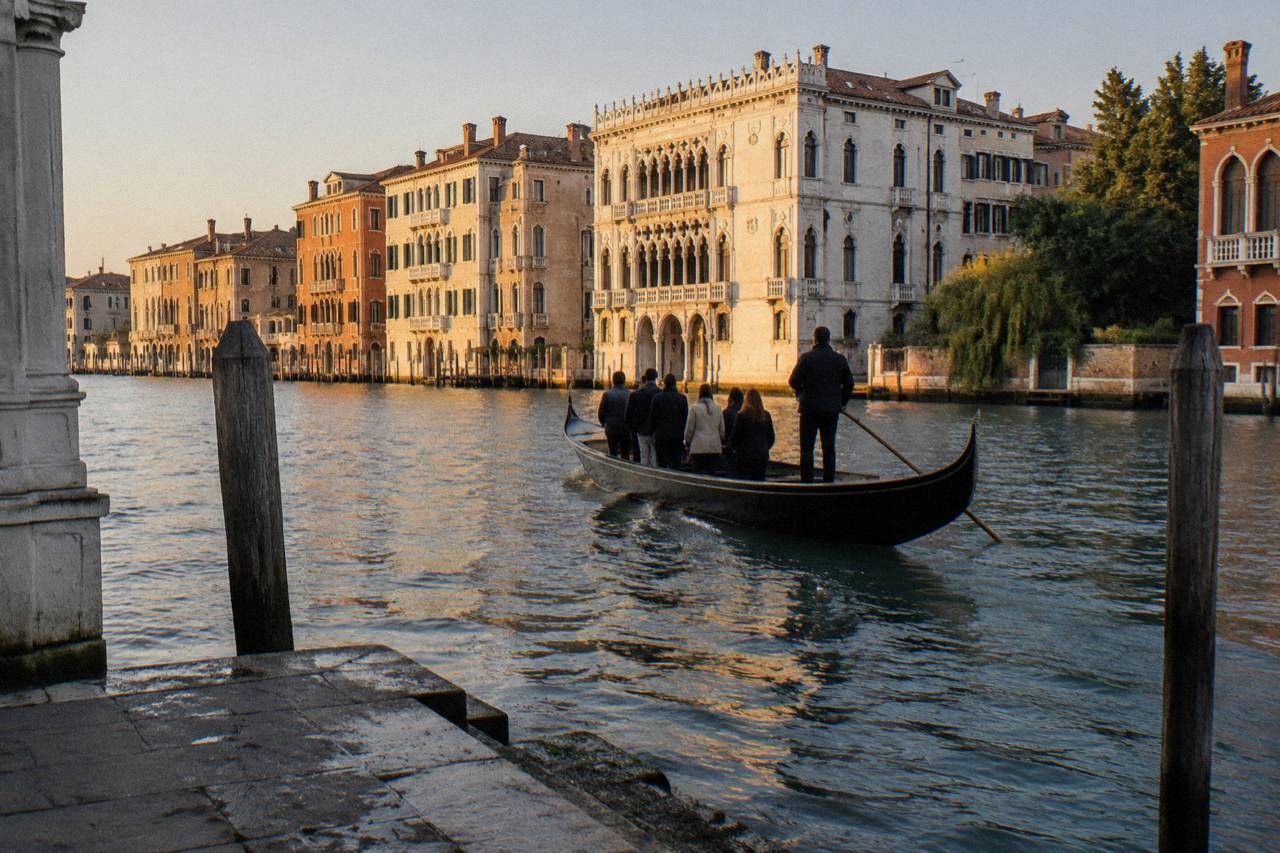
The arithmetic favours passes quickly, but only for itineraries that genuinely need boats. Two single rides a day for three days already costs more than the 72-hour pass. On the other hand, a visitor staying in Cannaregio and spending days walking to San Marco, Dorsoduro and the Rialto may only need one boat ride, to see the Grand Canal from the water, and the single fare is the rational buy. The decision is itinerary-shaped, not a matter of principle.
What does not exist is a free boat option for visitors. There is no complimentary water shuttle. The fare structure is stable: ACTV confirmed the same tariffs into the 2026-2027 season, so the numbers above should hold for planning.
The compensating fact is that Venice is one of the great walking cities precisely because it has to be. The historic centre is a dense pedestrian mesh where cars do not exist and every destination is a walk away, and the farther you get from the Rialto-San Marco axis, the more the walk itself becomes the sight. The vaporetto, in that sense, is a paid convenience layered over a free fundamental.
What Can You Actually Do In Venice For Free?
A great deal: Piazza San Marco, the Rialto Bridge, the Ghetto streets, the Punta della Dogana waterfront, the entire walkable surface of Murano, Burano and Torcello, Libreria Acqua Alta and every canal-side calle in between cost nothing to enter. The city's churches split by regime, with two independent churches charging EUR 8 and EUR 3.50, and St Mark's Basilica at EUR 10.
The free layer rewards a shift of ambition. Instead of asking which paid door to open, the free itinerary asks which walk to take, and Venice answers that question better than almost any city. The stretch from Campo San Polo across the Rialto into Cannaregio is a sequence of public space, market ground and bridge views that no ticket improves. The northern districts around Castello and Cannaregio give up their atmosphere for nothing, and the islands are free to walk end to end, with only their museums and the Torcello cathedral carrying tariffs.
Bookshops and oddities help too. Libreria Acqua Alta, the famous bookshop where volumes are stored in gondolas and bathtubs against flooding, is free to walk into and browse, open about 09:00 to 19:15. The Festa della Madonna della Salute on 21 November 2026 builds a votive bridge across the Grand Canal and costs nothing to attend, and Festa de San Martino falls on 11 November. Carnevale's street events, when the programme publishes, are open-air and free to watch.
For a paid-by-choice version of the same idea, the free walking tours are the city's best value, and 17 of them ship on this site across GuruWalk and freetour.com. The Rialto And Secret Spots Walk by Free Walk in Venice with guide Lucia, rated 4.92 out of 5 across 366 GuruWalk reviews, runs 2 hours in English from Campo San Polo, and the whole roster is laid out in the free walking tour guide.
Where Do Tourists Overspend In Venice?
In three places: single-ride vaporetto tickets bought repeatedly, full-price monument bundles bought on impulse, and anything bought within two streets of Piazza San Marco. None of the big compulsory costs, the access fee, transport, the occasional paid church, is where budgets break. The damage comes from small repeated charges and convenience purchases in the tourist core.
The single-ride trap is arithmetic: four solo boat trips cost EUR 38, more than a 24-hour pass plus change. The monument trap is sequencing: visitors who buy every add-on at St Mark's, entry, Pala d'Oro, museum and terrace, arrive at EUR 30 per person without deciding to. None of these are scams, the prices are posted and official, but they compound for anyone planning on the fly. Deciding the night before which two paid interiors actually matter to you is the single biggest saving available.
What can be said is structural: the tourist core around San Marco is where prices peak, and every street you walk away from it pushes costs down. The same logic applies to sights. The churches worth a tariff, the Frari at EUR 8, Santi Giovanni e Paolo at EUR 3.50, sit outside the core and cost a fraction of the San Marco monuments, and the walk to them passes through exactly the Venice most visitors say they came for.
There is also a timing dimension. Acqua alta season, October to March with its peak in November and December, deters crowds but transforms low-lying areas like Piazza San Marco, where water can start appearing from tides of around 80 cm even though the MOSE barriers rise at forecasts above 110 cm. The official acqua alta guidance is the source for tide planning, and Centro Maree publishes forecasts and alerts. Low season costs less and feels different, at the price of weather risk.
The last overspend is paying for a guide at all. The pay what you want walks below cover the essential, hidden and northern Venice on foot, each led by an independent local guide, each free to book with the tip set afterwards at your own judgement.
Common Questions About Venice Costs
Is Venice Expensive For Tourists?
Parts of it are: the access fee charged day visitors EUR 5 or EUR 10 on 60 days in 2026, boats cost EUR 9.50 a ride, and major monuments run EUR 10 to EUR 35. But the squares, bridges, islands and a full roster of pay what you want walking tours cost nothing you do not choose to spend, so the total depends mostly on your choices.
How Much Is The Venice Access Fee?
The 2026 trial charged EUR 5 if paid by the fourth-to-last day before the visit and EUR 10 in the last four days, on 60 days between 3 April and 26 July 2026, 08:30 to 16:00. That season has ended. No official 2027 dates or amounts have been published, so check the official portal before travel.
Do Overnight Visitors Pay The Access Fee?
No, but they must register. Overnight guests in accommodation inside the Comune di Venezia are exempt from the access fee, yet fall under the exempt-but-register rule and need a QR code from the official portal. The tourist tax paid through accommodation is a separate charge.
What Is The Cheapest Way To Get Around Venice?
Walking. Venice is compact and car-free, and most of the historic centre is reachable on foot at no cost. When you do need a boat, a 24-hour ACTV pass at EUR 25 beats repeated single tickets at EUR 9.50 each within two rides a day.
Are The Free Walking Tours Really Free?
They are free, pay what you want: booking costs nothing and the guide is paid by whatever you choose to tip at the end. The 17 walks listed on this site run on GuruWalk and freetour.com, operated by independent local guides, and no money figure attaches to any of them.
Which Venice Sights Are Free To Enter?
Piazza San Marco, the Rialto Bridge, the Ghetto streets, the Punta della Dogana waterfront, Libreria Acqua Alta and the walkable surface of Murano, Burano and Torcello all cost nothing. The Gallerie dell'Accademia is free on the first Sunday of the month under Domenica al Museo, EUR 20 otherwise.